The Next Frontier: How Immersive Learning Environments and AI Are Cultivating Higher Order Thinking Skills
Education is undergoing a seismic shift, driven by the convergence of artificial intelligence and immersive technologies. These innovations are not merely enhancing traditional learning methods but are fundamentally redefining how students engage with knowledge, develop critical thinking, and apply skills in real-world contexts. At the heart of this transformation lies the fusion of immersive learning environments and AI, a combination that is unlocking unprecedented opportunities for cultivating higher order thinking skills.
The Rise of Immersive Learning Environments
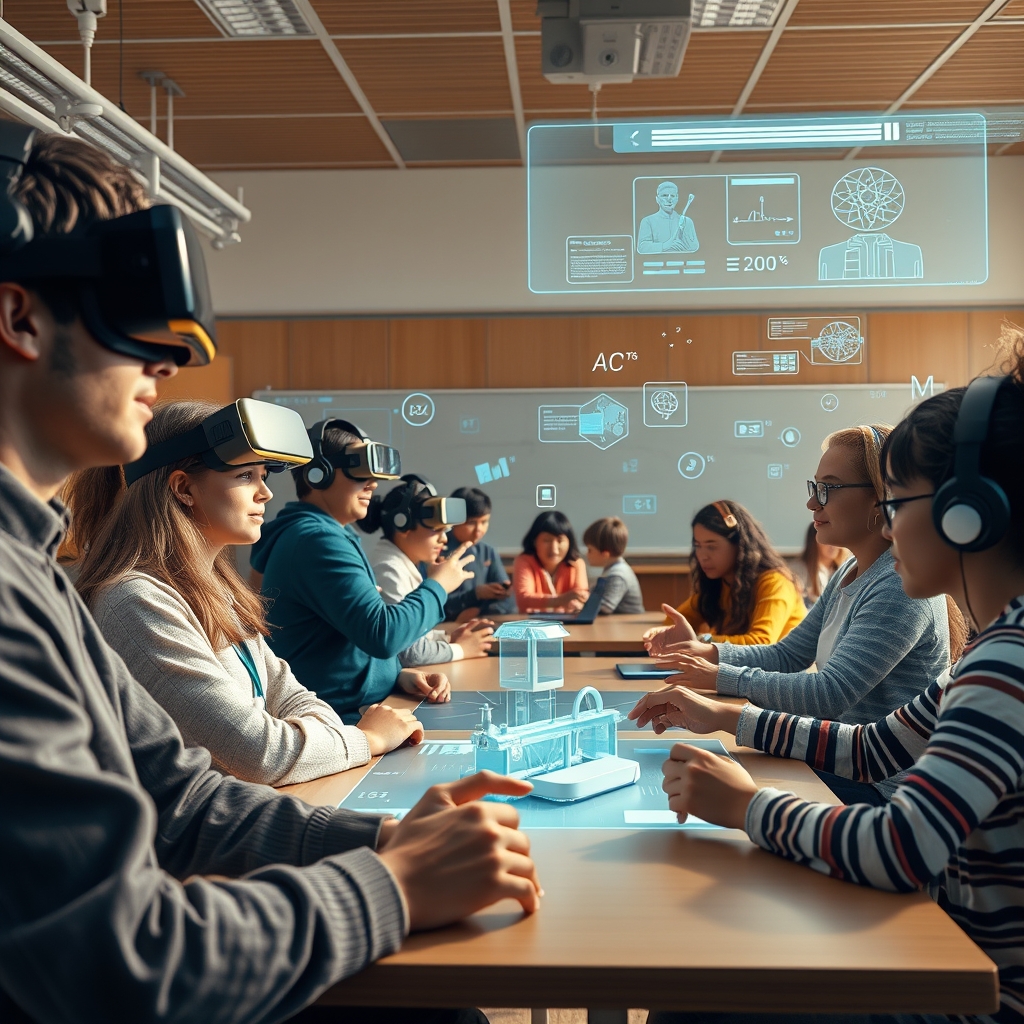
Immersive learning environments, powered by virtual reality (VR), augmented reality (AR), and mixed reality (MR), are breaking the boundaries of conventional classrooms. These technologies create dynamic, interactive spaces where learners can explore complex concepts through experiential learning. For instance, medical students can perform virtual surgeries, history students can walk through ancient civilizations, and engineering students can manipulate 3D models of mechanical systems—all within a risk-free, engaging environment.
The impact of these environments extends beyond engagement. Research shows that immersive learning significantly enhances retention and comprehension by leveraging the brain’s natural ability to remember experiences more vividly than abstract information. When students are actively involved in their learning—whether through simulations, gamified scenarios, or collaborative projects—they develop deeper cognitive connections to the material. This shift from passive absorption to active participation is a cornerstone of developing higher order thinking skills, such as analysis, evaluation, and creation.
The Role of AI in Personalizing Immersive Learning
While immersive technologies provide the canvas for experiential learning, artificial intelligence acts as the brush that personalizes the experience. AI-driven adaptive learning platforms analyze student interactions within immersive environments, identifying strengths, weaknesses, and learning preferences in real time. This data allows the system to dynamically adjust the difficulty, pacing, and content of the experience to suit each learner’s unique needs.
For example, an AI-powered VR history lesson might detect that a student struggles with understanding the causes of a historical event. The system can then provide additional contextual information, pose thought-provoking questions, or even alter the narrative to emphasize key factors. This level of personalization ensures that students are not merely passive observers but active participants in their learning journey, constantly challenged to think critically and solve problems.
Moreover, AI enhances immersive learning by facilitating natural language processing (NLP) and conversational interfaces. Students can engage in dialogues with virtual characters, ask questions, and receive instant feedback, mimicking real-world interactions. This fosters communication skills, collaboration, and the ability to articulate complex ideas—all of which are essential components of higher order thinking.
Bridging the Gap Between Theory and Practice
One of the most significant advantages of immersive learning environments is their ability to bridge the gap between theoretical knowledge and practical application. Traditional education often struggles to make abstract concepts tangible, leaving students to grapple with how to apply what they’ve learned in real-world scenarios. Immersive technologies eliminate this disconnect by placing learners in situations where they must use their knowledge to navigate challenges, make decisions, and see the consequences of their actions.
Consider a business student using a VR simulation to manage a virtual company. They must analyze market trends, make strategic decisions, and adapt to unforeseen challenges—all while receiving real-time feedback on their performance. This hands-on approach not only reinforces theoretical concepts but also hones problem-solving skills, adaptability, and creative thinking. These are the very skills that employers increasingly demand in a rapidly evolving workforce.
Fostering Inclusivity Through Immersive and Adaptive Learning
Inclusive education is another area where immersive learning environments and AI are making a profound impact. Traditional classrooms often struggle to accommodate diverse learning needs, whether due to physical disabilities, cognitive differences, or language barriers. Immersive technologies, however, can be tailored to create accessible and equitable learning experiences for all students.
For instance, VR can provide visually impaired students with audio descriptions of virtual environments, while AR can overlay text translations for non-native speakers. AI-driven adaptive platforms can also adjust content delivery to match individual learning styles, ensuring that every student has the opportunity to thrive. By removing barriers to access, immersive learning environments democratize education, making it possible for all learners to develop higher order thinking skills regardless of their background or abilities.
The Future of Workforce Development
As industries continue to evolve, the demand for employees who possess not only technical skills but also higher order thinking abilities is growing. Immersive learning environments, combined with AI, are uniquely positioned to prepare students for this future. By providing realistic, engaging, and personalized learning experiences, these technologies equip learners with the critical thinking, creativity, and adaptability needed to succeed in an increasingly complex world.
For example, microlearning modules delivered through VR can offer just-in-time training for employees, allowing them to upskill or reskill in a matter of hours rather than weeks. Gamified learning environments can make professional development engaging and interactive, while predictive learning analytics can identify skill gaps and recommend targeted interventions. This approach ensures that workforce development is not only efficient but also aligned with the needs of both employees and employers.
The integration of immersive learning environments and AI into education is not just a trend—it is a fundamental shift in how we prepare learners for the future. By fostering higher order thinking skills, personalizing learning experiences, and breaking down barriers to access, these technologies are redefining what it means to be educated in the 21st century. As we continue to explore the possibilities of this synergy, one thing is clear: the classrooms of tomorrow will be more dynamic, inclusive, and empowering than ever before, equipping students with the tools they need to navigate an increasingly complex and interconnected world.